Mention environmental law to most South African business owners and the picture that comes to mind is a mine, a petrochemical plant or some other large industrial operation. That assumption is understandable, but it is wrong, because NEMA compliance in South Africa reaches a far wider range of businesses than most owners realise. The National Environmental Management Act 107 of 1998, together with the specific Acts that sit beneath it, creates legal obligations for operations as ordinary as:
- a restaurant that generates used cooking oil;
- a workshop that stores fuel and produces waste solvents;
- a farm that uses pesticides near a wetland;
- a bakery with a coal-fired oven; or
- an events company that sets up on sensitive land.
Obligations most owners don’t know they have
Every one of these businesses carries specific legal obligations under South African environmental law, and a great many of them have no idea that they do. This article explains what NEMA actually covers, what a “listed activity” is, who needs an Environmental Authorisation and how to obtain one, and what the consequences are of operating without one, so that you can judge for yourself whether your own operation is exposed.
NEMA’s Scope: Broader Than You Think
NEMA is the framework legislation that governs environmental management in South Africa. It does not stand alone, but is supported by a family of specific Acts that deal with particular aspects of the environment in far greater detail. For most businesses, the ones that matter are:
- the National Environmental Management: Waste Act 59 of 2008 (NEMWA);
- the National Environmental Management: Air Quality Act 39 of 2004 (NEM:AQA); and
- the National Water Act 36 of 1998.
The principles behind the law
NEMA also establishes a set of fundamental principles that apply to all development and to all activities that may affect the environment. Three of them matter most to business owners:
- The preventive principle: prevent environmental damage at its source.
- The precautionary principle: where potential harm is uncertain, act with caution.
- The polluter pays principle: whoever causes the damage pays to fix it.
No proof of harm required
These principles are not aspirational statements to be quoted in a company policy and then forgotten; they form the legal foundation against which regulators make enforcement decisions and against which the courts reach their findings. What this means in practice is that environmental law in South Africa does not require proof of actual harm before it can be enforced. The obligation is to prevent harm in the first place, and if your operation has the potential to cause environmental damage, you are expected to have controls in place whether or not any damage has yet occurred.
What a “Listed Activity” Is
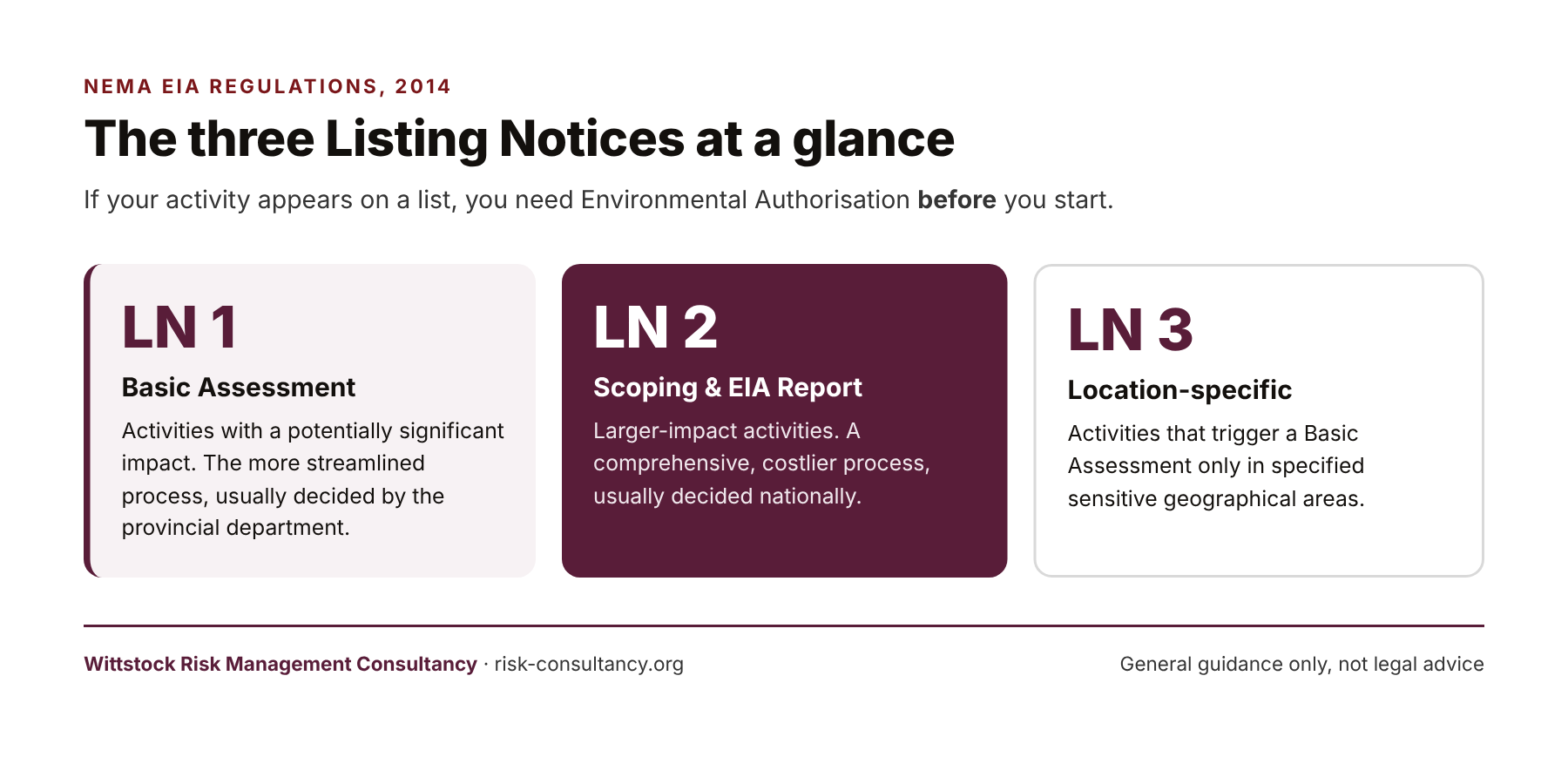
Under Section 24 of NEMA, the Minister of Forestry, Fisheries and the Environment has published lists of activities that may not be commenced without prior Environmental Authorisation. These lists form part of the Environmental Impact Assessment (EIA) Regulations, 2014, and are divided into three Listing Notices, each of which carries a different level of assessment.
More industries than you’d expect
The listed activities cover a far broader range of industries than most people would expect, and among them are:
- certain construction and infrastructure development above set thresholds;
- waste management, such as storing or sorting waste and running a composting facility;
- storage of dangerous goods above certain volumes;
- some food processing activities, particularly those involving emissions;
- filling stations and fuel storage above defined thresholds; and
- agricultural activities involving land clearing, drainage or work near water bodies.
Why the thresholds matter
Determining whether your particular operation triggers a listed activity is not always straightforward, because the descriptions in the notices are detailed and often technical, and because the thresholds matter a great deal: an activity is triggered only once it reaches a certain scale. This is precisely where a proper Environmental Compliance Screening earns its keep, since it applies each notice to your specific circumstances instead of leaving you to make that determination on your own.
Environmental Authorisation: Who Needs One
An Environmental Authorisation, commonly referred to as an environmental permit although “authorisation” is the formal term, is the legal approval that must be obtained before a listed activity may be undertaken. It is issued by the relevant Competent Authority, which for most Listing Notice 1 activities is the provincial environmental department and for Listing Notice 2 activities is usually the national Department of Forestry, Fisheries and the Environment.
How long the process takes
A Basic Assessment takes several months at the very least and will ordinarily involve a registered Environmental Assessment Practitioner. Once a complete application has been submitted, the Competent Authority has 107 days in which to reach a decision, but the preparation of the application itself, including the required public participation process, takes considerably longer than that in practice, and owners who leave it until the last moment invariably find themselves waiting.
Before, not after
The critical point is that the authorisation must be obtained before the activity begins, not after it is already under way. It is possible to regularise an operation that is already running through a process known as rectification, but that route is more expensive, more complicated and by no means guaranteed to succeed, and the fact that you did not know an authorisation was required is not a defence.
The penalties for operating without one
Operating a listed activity without an Environmental Authorisation is a criminal offence under NEMA. For a first offence the penalty may be a fine of up to R5 million, imprisonment of up to ten years, or both, and the courts may also order the person convicted to rehabilitate the environment at their own cost and to repay the full cost of any remediation that the state has already undertaken.
Waste: The Obligation That Catches Most Businesses Off Guard
NEMWA defines “waste” very broadly, as any substance that has been discarded or declared to be waste, whether or not it is capable of being reused, recycled or recovered. The Act distinguishes between general waste and hazardous waste, and the two are managed under different regulatory requirements. Most businesses generate considerably more than ordinary municipal refuse without ever thinking of it as regulated waste, and common examples include:
- used cooking oil is waste;
- waste solvents, lubricants and cleaning agents are waste;
- old refrigerants, batteries and electrical equipment fall under hazardous waste categories; and
- paint, pesticides and certain laboratory chemicals are hazardous waste.
Your duty of care doesn’t end at the gate
The obligations under NEMWA follow your waste from the moment it is generated to the moment it is finally disposed of, and your responsibility does not end simply because the waste has left your premises.
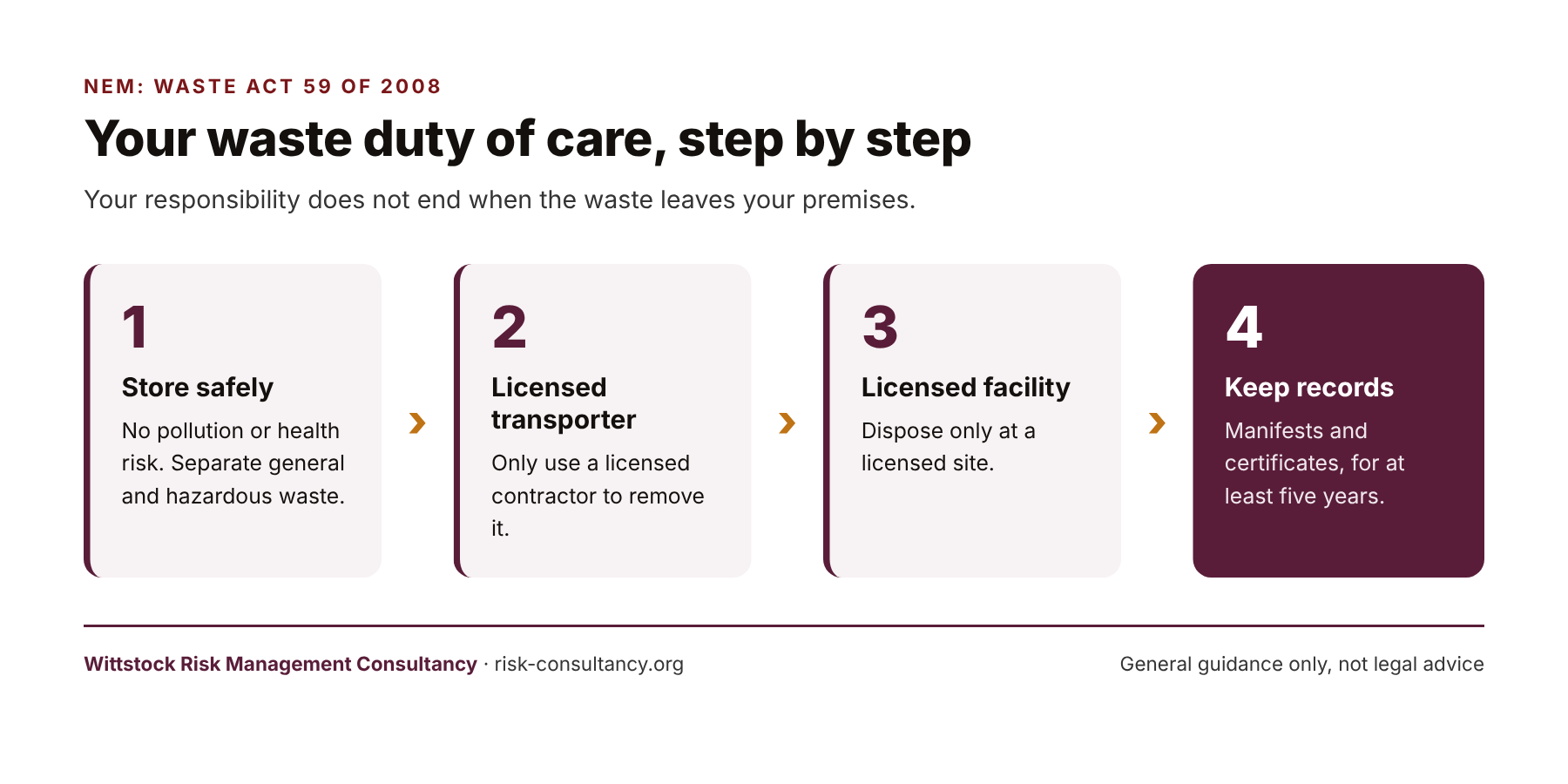
For businesses that generate hazardous waste there are additional obligations concerning classification, storage, labelling and disposal, and in some cases a waste management licence is required for the storage activity itself, which is a requirement that catches a surprising number of workshops and small manufacturers unawares.
Air Quality and Water: The Most Commonly Missed Obligations
NEM:AQA establishes a system of atmospheric emission licences for activities that release pollutants into the air. The activities that require a licence are set out in the published “List of Activities which Result in Atmospheric Emissions”, and they include combustion processes above certain heat-input thresholds, certain chemical processes, spray painting, mineral processing, and some food and beverage production processes. If your operation involves a boiler, kiln, generator, furnace or any other combustion process above the thresholds in the regulations, you may well require an atmospheric emission licence from your local air quality officer, and this applies as much to bakeries and food manufacturers as it does to smelters and heavy industry.
When you need a water use licence
Under the National Water Act, a water use licence is required for a number of water use activities, including:
- taking water from a water resource;
- storing water;
- impeding the flow of a watercourse;
- stream flow reduction activities;
- discharging waste, or water containing waste, into a water resource; and
- disposing of waste in a way that may harm a water resource.
Many of these activities are covered by “general authorisations”, which permit the activity within defined limits without the need for a full licence. Those limits matter, however, and you need to know with certainty whether your operation falls within them or outside them, because assuming the former when the latter is true is a common and expensive mistake.
The Enforcement Reality
A changing enforcement climate
Environmental enforcement in South Africa has historically been inconsistent, and it is a fact on which some business owners have relied, in certain cases for many years. That situation is changing. Integrated environmental management is receiving more dedicated resources at both provincial and national level, and civil society organisations and affected communities are increasingly willing to use the legal mechanisms available to them to enforce compliance against businesses that operate in their areas.
Pressure from insurers and clients
For most small and medium-sized businesses, however, the more immediate exposure comes from insurers and clients rather than from the regulator, since:
- commercial insurers increasingly ask whether environmental authorisations are in place before issuing or renewing cover; and
- larger retail and food manufacturing clients ask suppliers for environmental compliance documents as part of their due diligence.
The enforcement that matters most to an SME is therefore very often not a regulator at all, but a lost contract or a rejected insurance claim, either of which can do more damage to a small business than a fine.
Where to Start with NEMA Compliance
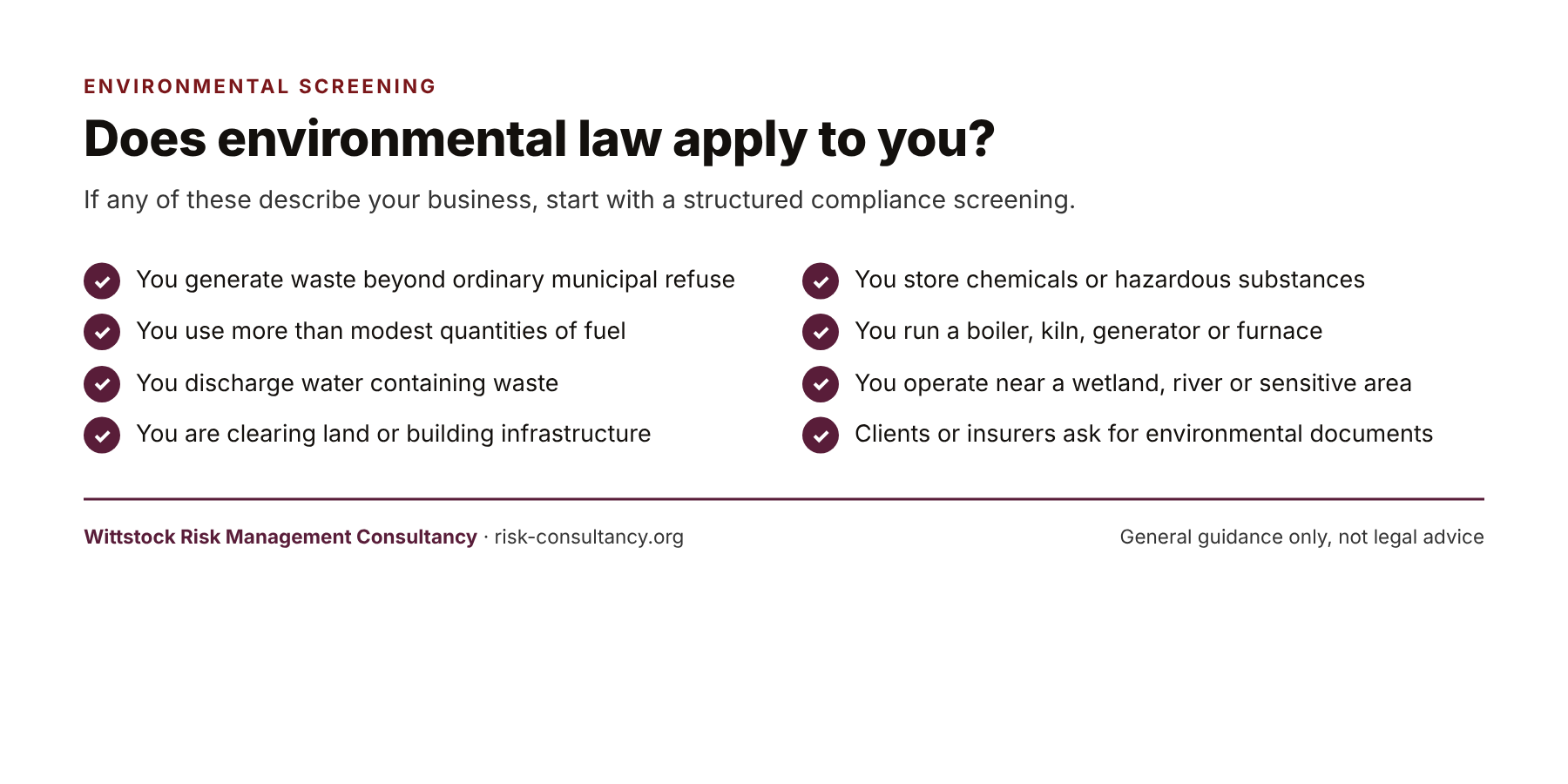
The starting point is a clear-eyed assessment of what your operation actually involves, as opposed to what you assume it involves from an environmental point of view. Most business owners have never looked at their operations through this lens at all, which means that there are frequently straightforward compliance obligations sitting unaddressed, waiting to be discovered by an inspector, an insurer or a client.
A free screening checklist
I have built a free Environmental Compliance Screening Checklist that covers the key requirements under NEMA, NEMWA, the Air Quality Act and the National Water Act. It is designed to be completed by a business owner without any legal training, and it will give you a clear indication of which obligations are likely to apply to your operation.
Download the Environmental Compliance Screening Checklist →
Get advice before you act
If your screening identifies possible listed activities or other significant compliance gaps, I would strongly suggest discussing the results before acting on them independently. The stakes under environmental law are high enough that getting the approach right from the outset matters a great deal, and a short conversation at the beginning can save a considerable amount of time and money later on. You are welcome to book a free telephonic consultation with no obligation, and we can go through your results together and agree on the sensible next steps for your operation.