The knock on the door from a food safety inspector is one of the most dreaded moments in any food business owner’s week. Yet the truth is that the businesses that fail inspections are not necessarily the dirtiest or the most careless; very often they are simply the ones that do not know what the inspector is looking for. I work with food businesses across the Western Cape to make sure that they are genuinely compliant rather than merely lucky, and this food safety inspection checklist sets out exactly what is on every inspector’s list, area by area, so that you can see your premises the way an inspector will.
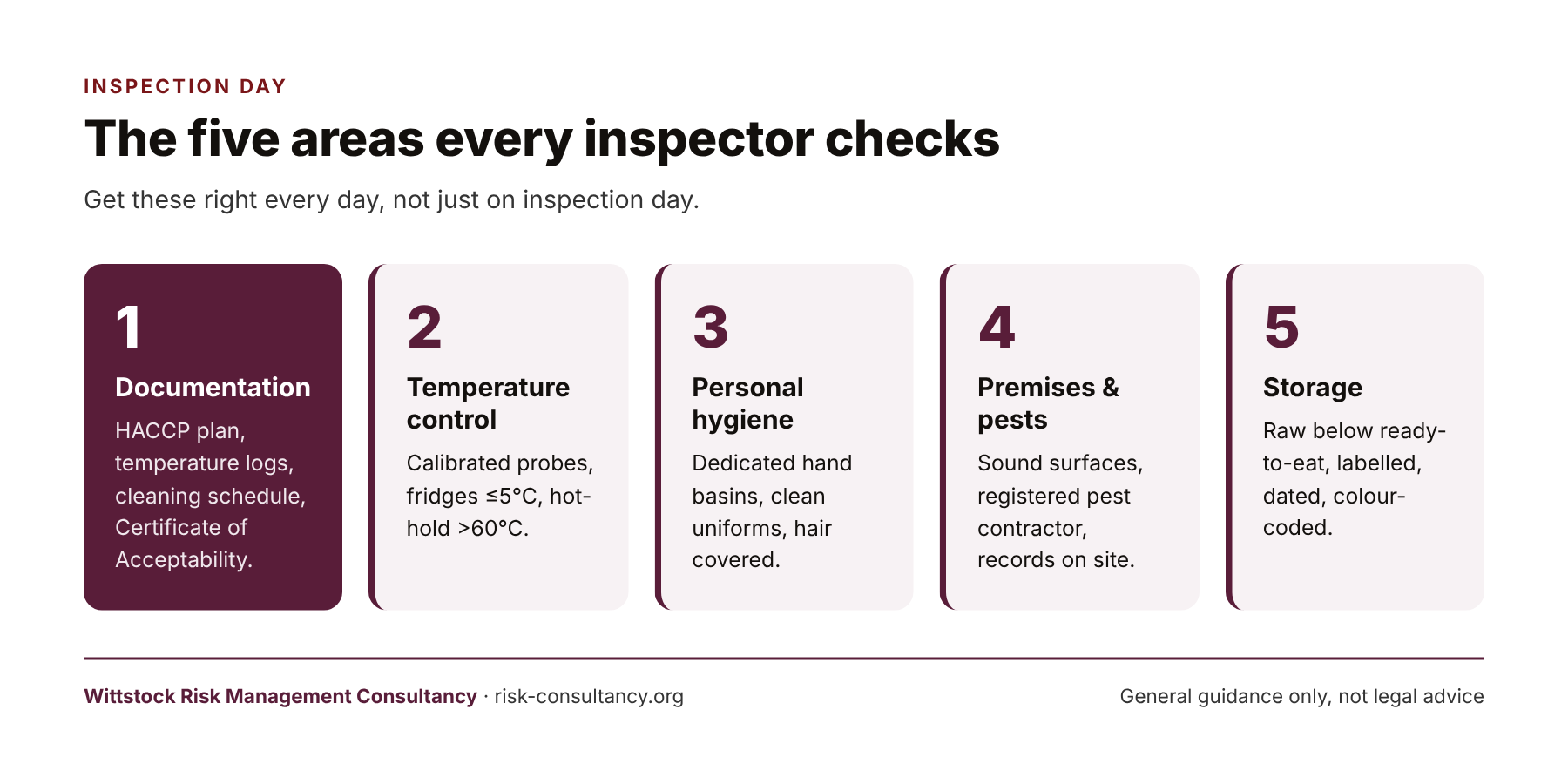
1. Documentation: Your Paper Trail Is Everything
The first thing an inspector asks for
Before an inspector walks through your kitchen, he or she will ask to see your paperwork, and this is the point at which many businesses fail before the inspection has properly begun. If any of the following documents is missing, out of date, or cannot be found quickly, you have already started on the back foot:
- your HACCP or food safety management plan, current and relevant to your menu;
- temperature logs for all fridges, freezers and hot-hold equipment;
- your cleaning and sanitation schedule, with daily sign-off;
- your Certificate of Acceptability from the local authority, issued under the Foodstuffs, Cosmetics and Disinfectants Act;
- staff food hygiene training records; and
- pest control records from a registered contractor.
Records that work every day
The aim is not to assemble a file for inspection day and then forget about it. These records should be kept in a way that is practical for day-to-day operation, so that they are always current and always to hand, because a well-kept set of records is the clearest evidence an inspector can find that your food safety system is a living thing rather than a formality.
2. Temperature Control: The Science Behind Safe Food
Keeping food out of the danger zone
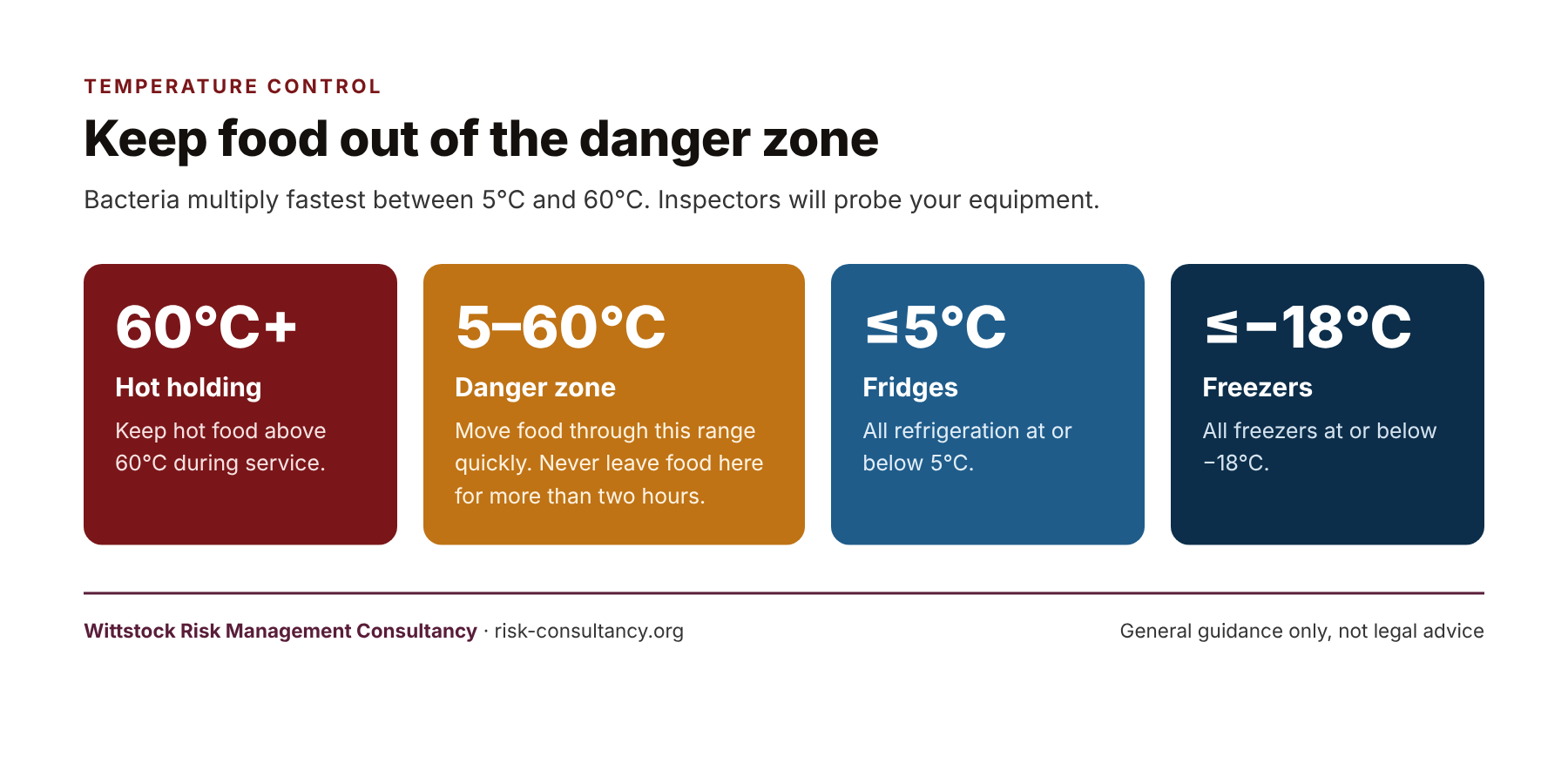
Bacteria thrive in what is known as the “danger zone”, the range between 5°C and 60°C, and your task is to keep food out of that range altogether or, where that is not possible, to move it through the range as quickly as you can.
What the inspector’s probe will check
You should expect the inspector to bring his or her own probe thermometer and to use it on your fridges, your freezers and your hot-hold equipment, and a fridge running at 8°C when it should be at 4°C will be treated as a critical failure rather than a minor oversight. The inspector will be looking for:
- all fridges at or below 5°C;
- all freezers at or below −18°C;
- hot-hold equipment keeping food above 60°C during service;
- calibrated probe thermometers, available and in use; and
- no food left in the danger zone for more than two hours.
It is equally important that your staff understand why these temperatures matter, and not merely how to write them down on a log sheet, because a team that understands the reason behind a control is far more likely to keep to it when nobody is watching.
3. Personal Hygiene: Your Staff Are Your Greatest Risk
What the inspector watches for
An inspector will observe your staff at work, and will notice whether they wash their hands at the right moments, namely after handling raw meat, after touching their faces and after using the bathroom, whether they are wearing clean uniforms and hair coverings, and whether jewellery has been removed. None of this is complicated, but all of it depends on habit, and habits are formed or broken by what supervisors tolerate during an ordinary shift.
Dedicated hand-washing facilities
Hand-washing basins must be dedicated to that purpose and must not be shared with the sinks used for washing dishes, and they must be stocked with soap and single-use paper towels at all times. It sounds simple, and it is, yet it remains one of the most commonly cited non-conformances in food premises across the country.
4. Premises and Pest Control
The condition of your premises
Inspectors pay close attention to the physical condition of the premises. Cracked tiles, peeling paint and water pooling behind equipment are all red flags, because each of them creates harbourage for pests and for bacteria, and each suggests to the inspector that maintenance is being deferred.
Pest control records on site
Your pest control contract must be held with a registered provider, and the treatment records must be kept on site where they can be produced on request. Any sign of rodent or cockroach activity during an inspection is usually treated as a critical failure, and it can lead to the immediate closure of the premises until the problem has been resolved.
5. Food Storage and Cross-Contamination
Storage and colour coding
Raw proteins must always be stored below ready-to-eat foods, and all food must be labelled, dated and kept in sealed containers. Colour-coded chopping boards and utensils must be in use, and, just as importantly, staff must actually keep them separate in practice rather than reaching for whichever board happens to be nearest.
Practice must match procedure
The inspector is not trying to trick you. What he or she is checking is whether the practices on the kitchen floor match the procedures written in your documentation, and that is precisely why a genuine food safety culture matters more than perfect paperwork: the paperwork describes what should happen, but the inspector is there to see what does.
Getting Inspection-Ready
A snapshot of one day
An inspection is no more than a snapshot of your operation on a single day. If your documentation is in order, your temperatures are under control and your team understands why food safety matters, that snapshot will look good on any day an inspector chooses to call.
Run your own check first
I offer a comprehensive food safety gap assessment for businesses in the Western Cape. Use this food safety inspection checklist to carry out your own check before the real inspection happens, and then book a free telephonic consultation with no obligation, or call me on +27 (0)84 401 8446 to arrange a full assessment of your premises.